
The paper type versus the printmaking technique
Paper[1] establishes the conditions for a print project, i.e. the chosen technique determines the qualities required of the paper sheet. Printmakers can choose from several techniques—intaglio,[2] planographic,[3] relief,[4] stencil,[5] and monotype[6]—and each technique requires specific paper properties.
Paper for printmaking was called “Plate Paper” and “Matrix Paper”. In an 1814 publication Paper and its uses: a treatise for printers by Edward Dawe, Plate Papers are described as “[t]hick, soft printing papers, made of good material, soft-sized…[u]sed for taking impressions from engraved copper and steel plates, also for fine lithography.” Sutermeister in his book The Story of Papermaking (1962) lists Matrix Paper as “bulky, absorbent paper…for casting printing plates.” He explains that the paper “must have high compressibility and strength when wet…”.

Call and Response I
2015
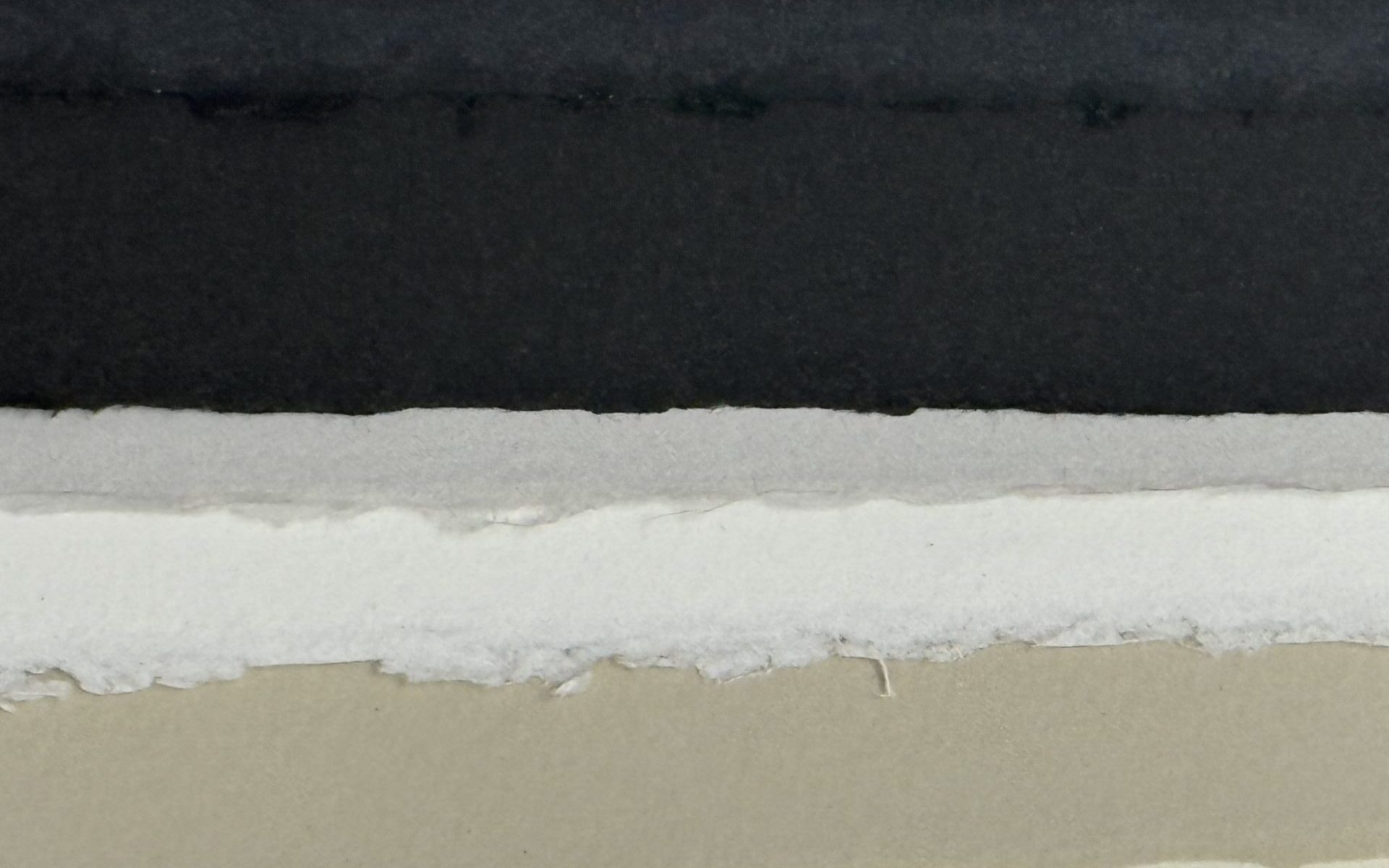
Diptych, etching on Somerset Black Velvet 250 g/m²
Edition of 15
Paper dimensions: 28,2 x 50,5 cm (both sections)
Published by Warren Editions
Intaglio
For intaglio, choose a paper that is soft, flexible, and absorbent; free of furnish[7] irregularities; and dimensionally stable,[8] especially for multi-plate work. Ideally, use a paper with light internal sizing[9] or a waterleaf [10] sheet. The sheet requires good wet strength because it must absorb water, tolerate handling while still damp and withstand blotting. Because printing a copperplate involves immense pressure, the paper also needs high burst strength to prevent cuts or cracks at the plate edge. The paper must withstand viscous etching inks, and its softness should allow it to pull ink from even the finest etched or thinnest drypoint lines.

Studio Life: The bullet has left the barrel
2021
Photogravure and drypoint on Hahnemühle Bütten Natural White 300 g/m²
Edition of 28
Paper dimensions: 44 x 54 cm
Impression dimensions: 28 x 42,5 cm
Published by David Krut Projects

Tent
2008
Softground, spitbite and aquatint on Somerset Satin 300 g/m²
Edition of 20
Paper dimensions: 38 x 44 cm
Impression dimensions: 24 x 29,5 cm
Published by Warren Editions
Planographic
When you print a solid area in planographic processes, such as a background tint, the pull on the paper’s surface becomes heavy. If the paper lacks sufficient strength and integrity, the surface will pick.[11] Pressure from the press stretches the paper, while moisture from sponging the stone with water causes it to expand. As a result, the paper requires substantial internal and surface strength. It should have a smooth, even finish, be relatively firm, and resist permanent stretch. Avoid fluffy papers; these have a loose texture and a tendency to shed fibre. This shedding, commonly known as linting, can clog the printing surface. You can use rough or textured papers for offset printing, but the offset blanket’s stretch and the paper’s surface texture can reduce colour intensity and fine detail.
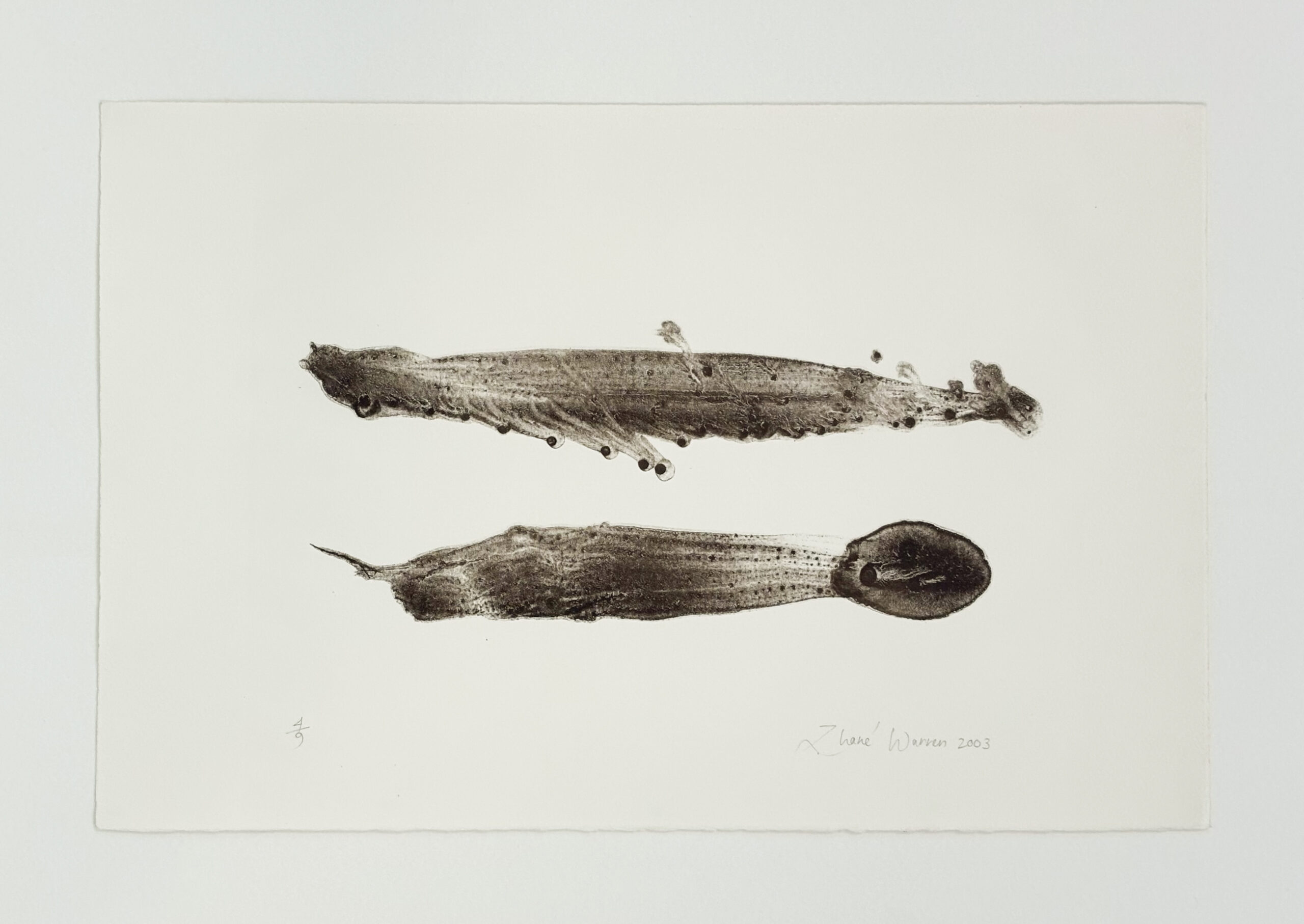
Untitled
2003
Lithograph on Somerset Textured Soft White 250 g/m²
Edition of 9
Paper & impression dimensions: 33 x 50 cm
Published by Artist
Relief
For relief printing (using type, woodcut and linocut with oil-based inks and a press), the paper should be smooth and receptive to ink, as printers generally work with it dry. Internally sized paper (avoid externally sized) works best. Choose a sheet resilient enough to maintain its form through successive layers of viscous ink, especially when printing from multiple blocks.

In good company
2016
Woodcut on Shin Torinoko White 120 g/m²
Edition of 18
Paper dimensions: 128 x 98 cm
Impression dimensions: 102 x 82 cm
Published by Warren Editions
Screenprint
In many respects, the requirements for relief and stencil/screenprint are similar. For best results in screenprint, choose internally sized paper; if you use an externally sized sheet, ensure it has moderate sizing. The aim is for the ink to penetrate the fibres to allow blending; a heavily surface-sized paper leaves the ink sitting on top and prevents effective colour mixing. Smooth paper promotes a sharper image and greater detail. This quality is especially useful for photographic screenprints, where a smooth surface enables the printer to use less pressure. The sheet should also offer enough dimensional stability and bulk[12] as this combination holds up well for multiple ink layers and maintain accurate registration. A medium- to heavyweight paper helps prevent buckling, particularly with water-based inks. As the impression size increases, increase the grammage as well; aim for 300 g/m²[13] or higher.
Monotype
For the painterly printmaking technique of monotype, choose a heavyweight, internally sized, bulky sheet, again around 300 g/m².

Theewaterskloof
2024
Monotype on Cordenons Wild 300 g/m²
Unique Print
Paper dimensions: 47 x 62 cm
Impression dimensions: 25 x 40 cm
Published by Warren Editions
In conclusion
Choosing the right paper is essential for achieving the desired results. Each paper type[14] has several distinguishing features. Identifying a suitable option becomes easier when you know which papers printers use for similar work. Build testing different papers into your projects and treat them as an integral part of the making process.


Atlas Mons
2010
Hand-bound Picture Book
Screenprint on Enigma Ivory 160 g/m² and 350 g/m²
Edition of 150
Book dimensions when closed: 15 x 12 cm
Published by Warren Editions
Footnotes
[1] The paper referenced in this text is mouldmade and machine-made paper. Mouldmade paper is produced on a Cylinder Mould Machine, combining the unique character of handmade paper with the consistency and scale of machine production, as the paper forms on a rotating cylinder mould. Machine-made paper, by contrast, is produced on a Fourdrinier machine or a Short Wire Machine (used in Japan), where the pulp is sprayed/poured onto a continuous wire web.
[2] The term intaglio (with a silent g, from the Italian word for incised) refers to a printing technique in which a matrix holds oil-based ink in grooves beneath its surface. Intaglio is the umbrella term for drypoint, engraving, etching, mezzotint, aquatint, photogravure, photo-etching, collagraph and photopolymer.
[3] Planographic printing is a family of printmaking techniques in which the image is carried on a flat surface, rather than being raised (relief) or recessed (intaglio). Lithography is the classic planographic method, and offset lithography is its widely used industrial form. Another is collotype a gelatin-based photomechanical printing process.
In lithography, the printable and non‑printable areas of the plate or stone lie on the same plane. What differentiates them is chemistry: grease‑accepting, water‑repelling areas carry the ink, while water‑accepting, grease‑repelling areas do not. During printing, the surface is repeatedly dampened and inked; the ink adheres only to the image areas and is then transferred under pressure to the paper.
[4] Relief takes its name from the fact that the raised surface of the matrix receives the ink. In a linocut or woodcut, for example, the non-printed areas are carved away with carving tools, leaving the matrix in relief. Ink is rolled onto this raised surface using a brayer or roller, and the image is then printed onto paper. The area below the surface that does not receive ink will retain the paper’s colour. The individuality of the relief lies in the energy, directness, authority, and spontaneity that can be imparted to the cut image with various carving tools.
[5] Stencil, commonly known as screenprint (formerly called silkscreen), is a printmaking method in which ink is forced through an open image on a mesh or stencil onto the paper beneath. Unlike intaglio or relief, the matrix does not rely on recesses or raised surfaces; instead, certain areas of the screen are blocked, while the open areas allow ink to pass through. Each pull deposits a relatively thick, even layer of ink, making the stencil ideal for flat colour fields, layered imagery, and graphic, high‑chroma prints.
[6] A monotype (in some degree a planographic method) is a unique print created from a surface that contains no permanent or repeatable marks. Each print is truly one of a kind, as the image cannot be recreated. In contrast, a monoprint features at least one element derived from a fixed matrix, such as an etched plate, carved block, or stencil, which can be reused to produce an edition. While each monoprint may be unique due to variations in colouring or additional hand-drawn elements, the presence of this repeatable matrix sets it apart from the monotype.
[7] The furnish describes the fibre content (cotton and alpha cellulose) and fillers, which together constitute a specific type of paper. However, manufacturers do not list the fillers used, except for the alkaline reserve of calcium carbonate, which is used to adjust pH.
[8] This refers to the degree to which a paper changes shape (which depends on the beating of the cellulose, the climate and the atmosphere).
[9] Sizing is a chemical solution added in papermaking to control the paper’s absorption of water and media (like watercolour and ink). It provides surface strength, and its amount affects flexibility. Sized paper is used for watercolour, writing and printing.
[10] Waterleaf paper, including blotting and many Asian papers, contains no sizing.
[11] Picking occurs when fibres lift from the paper’s surface when pulling a print.
[12] Bulk refers to how thick and voluminous a sheet of paper is relative to its weight. A paper with high bulk is relatively thick and “cushiony” for its grammage, while lower‑bulk papers are denser and more compact at the same weight.
[13] The international standard for expressing the weight of a sheet of paper is grams per square metre, shown with the symbol g/m². ‘gsm’ is a non-standard, invented abbreviation (Reference: https://ukma.org.uk/style-guide/). For help calculating the weight of a sheet of paper, use the PaperWeight application developed by Magnolia Paper.
[14] “Paper type” refers to the specific commercial name given to a paper, indicating a distinct product with its own combination of fibre furnish, weight, surface, and other properties. This name is often structured as [mill name] + [range/finish name], and in some regions, the same paper may be sold under an alternative name chosen by local suppliers.
Further reading
Antreasian, Garo & Adams, Clinton. 1971. The Tamarind Book of Lithography: Art & Techniques. Los Angeles: Tamarind Lithography Workshop Inc., New York: Harry N. Abrams, Inc., Publishers.
Brown, Kathan. 1996. Ink, paper, metal, wood: painters and sculptors at Crown Point Press. San Francisco: Chronicle Books.
Dawe, Edward. A. 1914. Paper and its Uses: A Treatise for Printers, Stationers and Others. New York: D. Appleton and Company. [Available, Internet Archive.]
Legrand, Wim. 2021. Screen Printing Basics. Cape Town: Black River Studio.
Saff, Donald & Sacilotto, Deli. 1978. Printmaking: History and Process. New York: Holt, Rinehart and Winston, Inc.
Sutermeister, Edwin. 1962. The story of papermaking. New York: R. R. Bowker Co. [Available, Internet Archive.]
Turner, Silvie. 1998. The Book of Fine Paper. London: Thames and Hudson.
van Velson, S. T. J. 2018. The universe between felt and wire: A new look into the typology of Western made paper. Amsterdam: University of Amsterdam.
Walker, George A. 2010. The Woodcut Artist’s Handbook: Techniques and Tools for Relief Printmaking. Canada: Firefly Books.
Wax, Carol. 1990. The Mezzotint: History and Technique. New York: Harry N. Abrams, Inc., Publishers.

Rousseau Vase
2014
Monotype on Hahnemühle Bütten White 350 g/m²
Unique Print
Paper dimensions: 226 x 126 cm
Impression dimensions: 200 x 100 cm
Published by Warren Editions