

The flat fibre web structure we recognise as a mere sheet of paper today exists because of a chemical reaction, namely, hydrogen bonding. The fibre in paper is cellulose[1], an insoluble material and the main structural component in all plants and trees, which has multiple layers of microscopic, hollow, thread-like fibrils.
 The empirical formula for cellulose is C6H10O5n (n refers to the degree of polymerisation).
Chemically, it is a natural long-chain polymer composed of repeating units of carbon, hydrogen and oxygen atoms. Within these chains are polar oxygen and hydrogen atoms forming hydroxyl groups (-OH). In preparation for papermaking, the cellulose is beaten so that the fibrils fibrillate[2] to provide a large surface area for bonding.
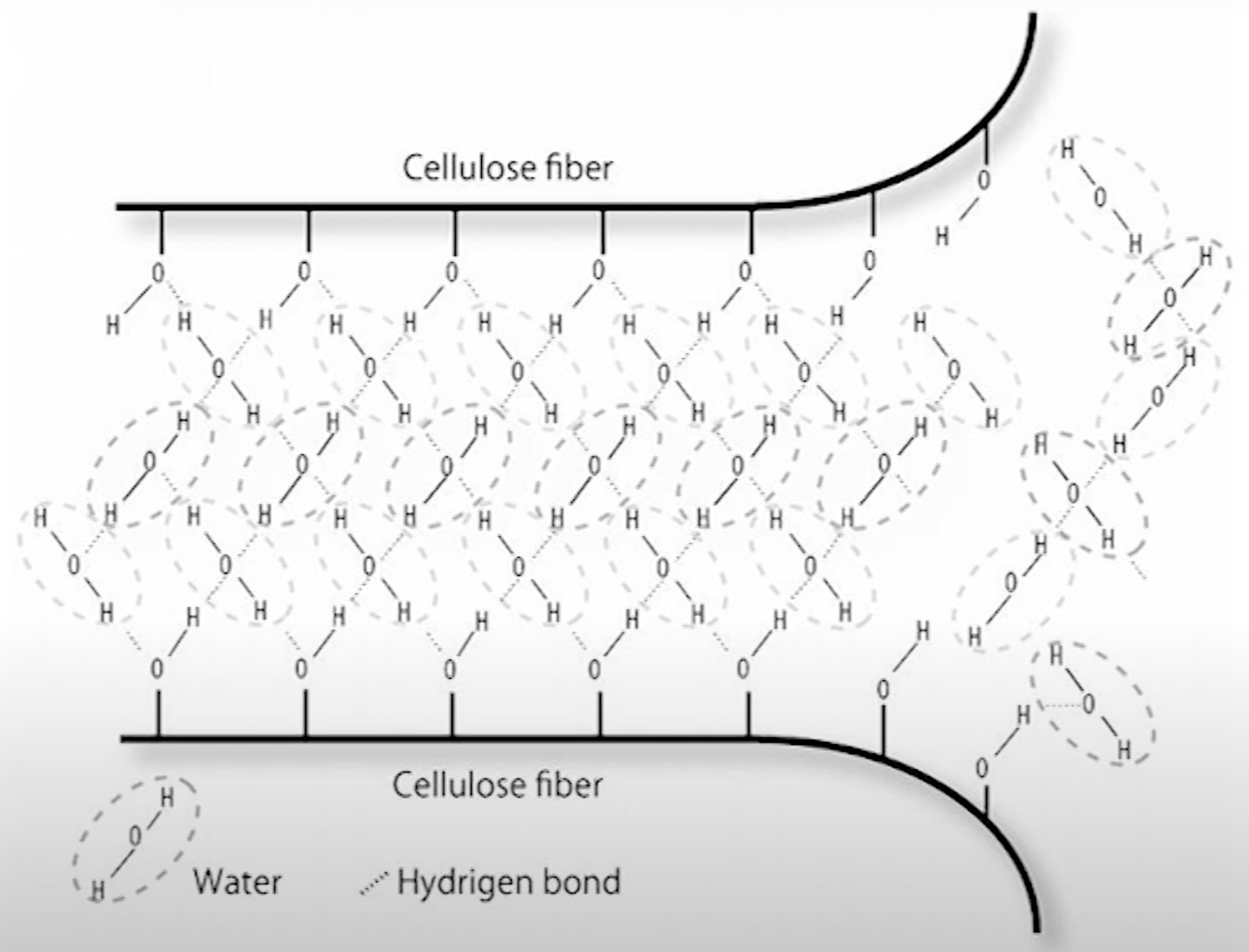


The beaten cellulose is a component of the pulp for papermaking, from which a web of fibre (i.e. paper) is formed. In the wet state, the positively charged hydrogen and negatively charged oxygen atoms from the hydroxyl groups in the cellulose form hydrogen bonds. This interaction causes the fibrils on the surface of the fibre to adhere together. As the web of fibre dries, continued hydrogen bonding occurs between the hydrogen atoms of the H2O molecules[3] positioned between the fibrils. When the H2O molecules migrate, i.e. evaporate, the hydrogen atoms in the cellulose molecules connect tightly and strengthen the hydrogen bonds because of the electrostatic[4] attraction of hydroxyl groups in the fibre with the polar[5] H2O molecules. Upon reaching an equilibrium between the H2O molecules in the atmosphere and the H2O molecules in the fibre, the web is dry, resulting in a robust flat structure, called paper[6].
This is what makes paper, paper.
Footnotes
[1] Discovered in 1838 by Anselme Payen.
[2] In other words split up with internal and external fraying.
[3] H2O molecules also known as water, has two hydrogen atoms linked to one oxygen atom.
[4] The hydrogen and oxygen atoms carry electrons.
[5] Polar because of the negative and positive charge of the hydrogen and oxygen atoms.
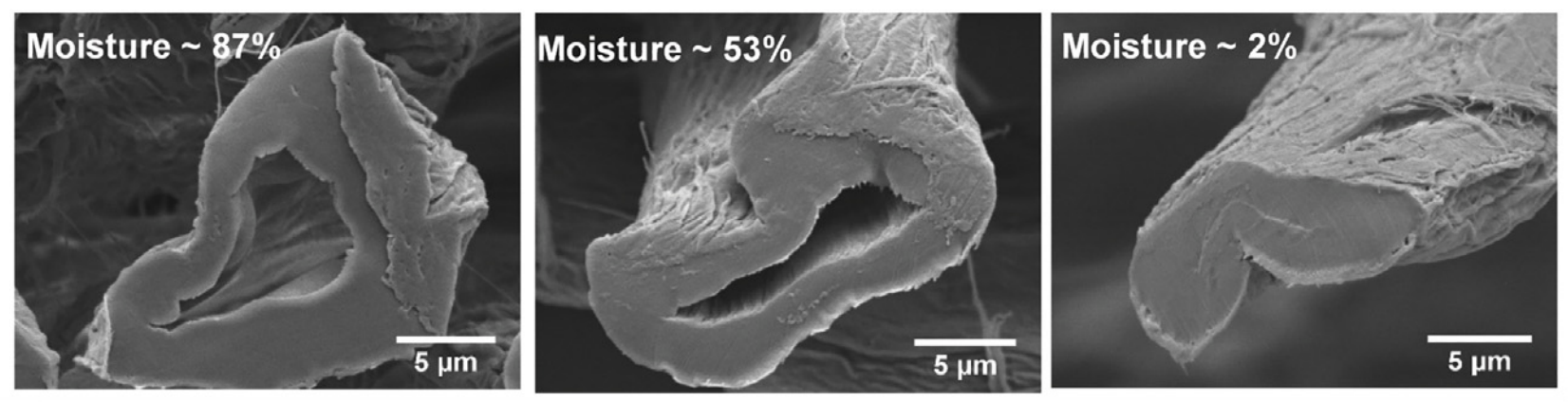
[6] After drying, paper still contains 5-10% H2O molecules. The percentage fluctuates as the seasons change. The paper, a cellulosic substance, maintains the polar properties of a cellulose molecule, making it a polar compound. Therefore, the paper is a “living” entity—expanding and contracting throughout its existence, depending on the environment it finds itself in.
For further reading
Banik, Gerhard & Brückle, Irene. 2011. Paper and Water: A Guide for Conservators. Oxford: Butterworth Heinemann.
Farnsworth, Donald & Stone, Nick. 2020. Determinate Hand Papermaking: Techniques for predetermining and making paper of known specifications and qualities. California: Magnolia Editions.