
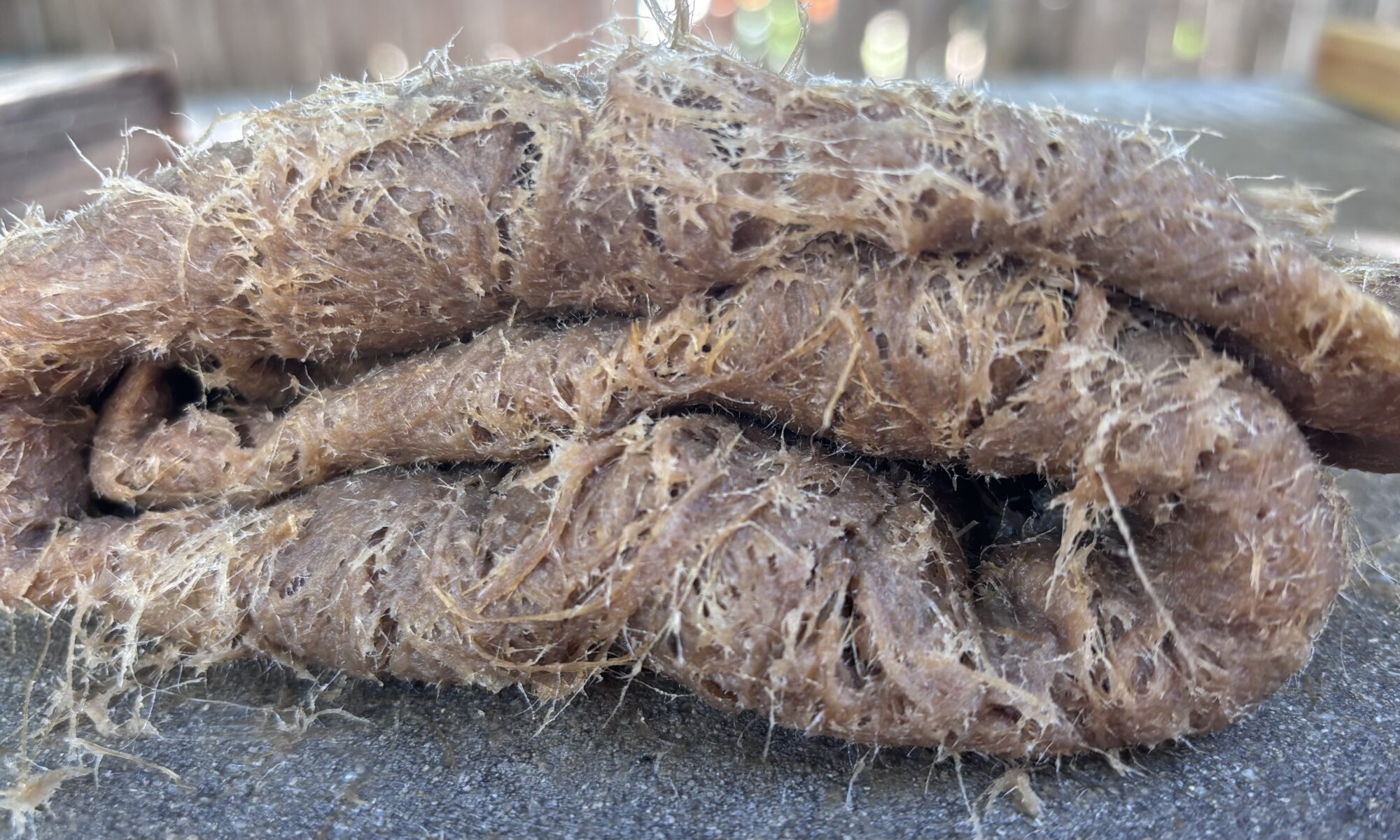
Cellulose is the main structural material in almost all plants and trees, and it is the key fibre used to make paper (together with water).
In chemical terms, cellulose:
- Was identified in 1838 by the French chemist Anselme Payen.
- It is a natural long‑chain polymer made of repeating units of carbon, hydrogen and oxygen atoms.
- Has the empirical formula C₆H₁₀O₅ₙ, where n is the degree of polymerisation — the number of units linked together in the chain.
- Contains many hydroxyl groups (–OH) along its chains. These –OH groups are essential because they enable cellulose fibres to bond with each other through hydrogen bonding.
Structurally, cellulose fibres consist of multiple layers of microscopic, hollow, thread‑like fibrils. During papermaking, when the fibre is beaten, these fibrils fibrillate (they split and fray internally and externally), greatly increasing the surface area available for bonding.
How cellulose makes paper possible
During papermaking, cellulose fibres are suspended in water. The hydrogen (positive) and oxygen (negative) atoms in the hydroxyl groups making up the cellulose form hydrogen bonds:
- While the fibres are wet, water molecules and hydroxyl groups interact so that fibrils on neighbouring fibres adhere to each other.
- As the sheet dries, these hydrogen bonds become stronger. The electrostatic attraction between hydroxyl groups on the cellulose and the polar H₂O molecules helps draw the fibres together.
- The result is a robust fibre mesh — the network of bonded cellulose fibres that we call paper.
Even after drying, paper still contains about 5–10% water. This water remains within the fibre structure, influencing the paper’s flexibility and dimensional stability.
Why cellulose is ideal for papermaking
Cellulose has a set of properties that make it exceptionally suitable for paper:
- High tensile strength – it forms strong sheets that tolerate handling and printing pressures.
- Flexibility – fibres can bend and interlock without breaking.
- Hydrophilic but water‑insoluble– it readily interacts with water (which is essential for bonding and sheet formation) but does not dissolve in it.
- Chemically stable – especially after lignin and other impurities are removed, cellulose can form durable, long‑lasting paper.
For this reason, whether the cellulose comes from cotton (very pure, long fibres), high alpha‑cellulose wood‑free pulp (high‑purity cellulose from wood), bamboo, straw, reeds, grass, flax, bast fibre or hemp, it is the primary component that determines the strength and stability of paper.