
A materially informed approach to dampening paper for stable, successful printmaking — and why controlled dampening outperforms soaking.

For intaglio printers, controlling how paper is dampened is as important as the plate or the ink. It is common to soak paper for extended periods, believing that more water makes it more flexible and yields better impressions. However, over-soaking quietly undermines the very properties that make good printmaking paper responsive and durable. It weakens the fibre network, damages the sizing, and reduces the sheet’s long-term stability. Wetpacking ensures the entire sheet absorbs moisture evenly and becomes sufficiently damp for printing. In practice, it delivers consistently damp paper that takes ink smoothly and uniformly.
This text makes the case for an alternative: the wetpack. By bringing each sheet to a controlled, even level of dampness, wetpacking preserves the paper’s internal structure while optimising its surface for receiving and holding ink. Drawing on fibre chemistry, paper physics and day‑to‑day print practice, it explains how wetpacking works, why soaking is damaging, and what is at stake for print quality, edition consistency and archival longevity.
Why the wetpack?
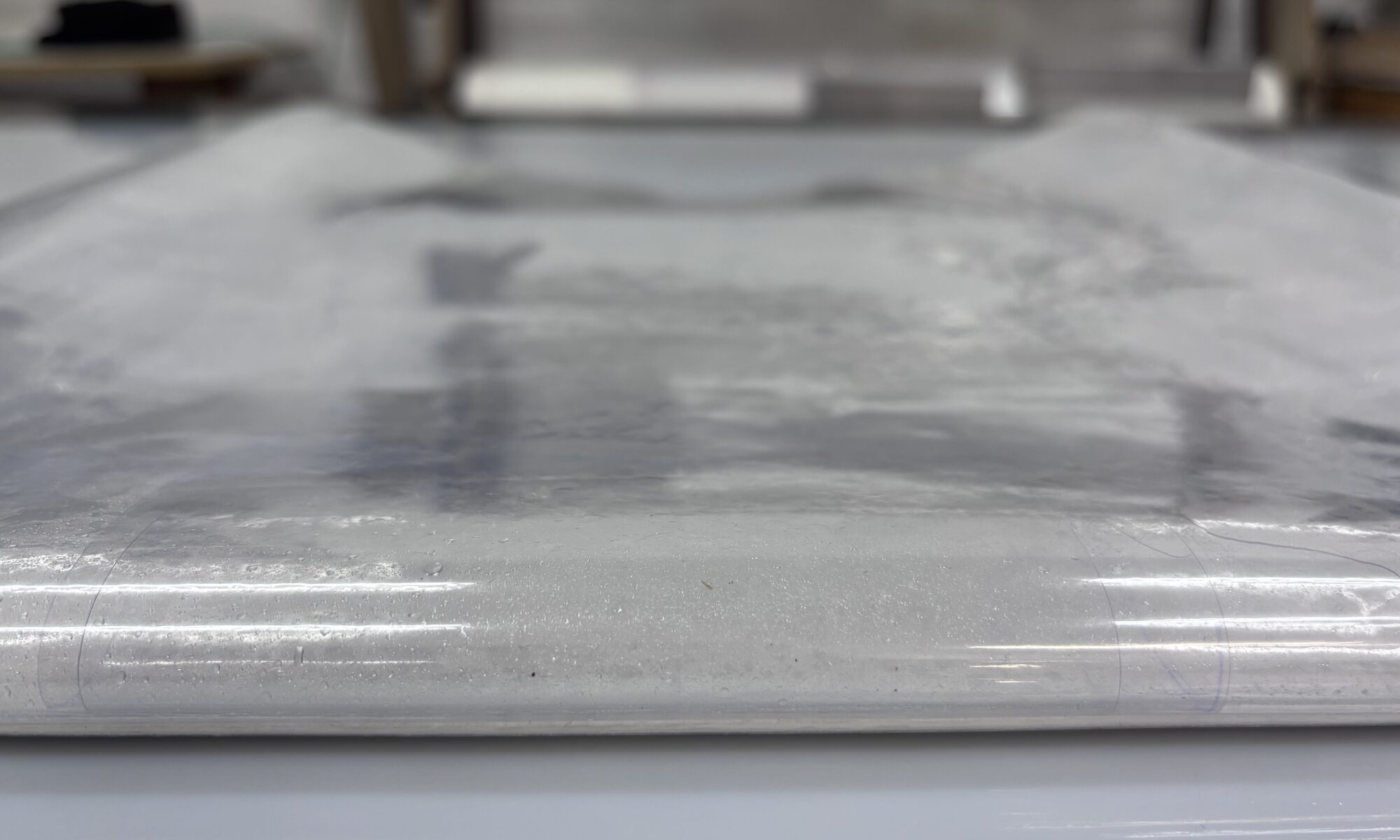
Wetting paper for intaglio is vital for absorbing the ink trapped in the grooves and pits of an etched plate. The recommended method is to use a wetpack rather than soaking the paper for extended periods. A wetpack involves wrapping damp paper tightly in a plastic sheet for a sufficient period, usually overnight, allowing water to be absorbed between and within the fibres. This process ensures the entire sheet reaches moisture equilibrium and becomes pliable for printing. Paper is ideal for printing when it has a damp, pliable, matte surface, is light in weight, and is cold to the touch. The wetpack maintains these qualities by exposing the fibres to a minimal amount of water in a carefully controlled, minimally invasive manner, resulting in a predictable level of dampness.
The penetration of water molecules into the paper in the wetpack causes two main effects: swelling and plasticisation. Swelling occurs as fibres absorb water and expand. Plasticisation is the point at which these fibres begin to behave less like a rigid board and more like a soft, flexible cloth: water loosens the intermolecular bonds within and between cellulose chains, making the fibre network more mobile and compliant under pressure.
Paper is made from cellulose fibres – long-chain plant polymers rich in hydroxyl (–OH) groups. During papermaking, these groups form countless hydrogen bonds as the sheet dries, creating a dense three-dimensional fibre network. This network gives printmaking paper its tensile strength, flexibility and ability to withstand pressure on the press.
As water enters, individual cellulose fibres swell as water penetrates their microfibrils and amorphous regions, increasing fibre volume and raising the paper’s surface energy, preparing it to receive ink. Water molecules also relax intermolecular hydrogen bonds within and between cellulose chains, boosting chain mobility. This plasticisation process makes fibres softer and more flexible. These effects modify the paper surface by increasing surface energy (enhancing absorbency) and expanding its surface area, making it more porous and permeable. This allows ink to penetrate deep into the fibres — especially under heavy pressure in intaglio printing — and to gather on the paper’s surface. Once dry, the ink is locked in the fibres, giving it a tangible quality and, in deep etching, creating a relief of the etched groove with ink. Since the paper is only briefly exposed to controlled water, wetpacking preserves the sheet’s sizing and calcium carbonate, maintaining its pH balance and archival stability.

Why not soak the paper?
Soaking weakens the paper and permanently damages its internal structure. Leaving paper in the water tray results in what I call “waterlogged” paper. Prolonged exposure to excess water floods the fibre network, breaking the hydrogen bonds within and between fibres by ‘washing them away’. This three-dimensional web of bonded fibres – the fibre network – has a fine internal geometry often called the paper’s microstructure. It determines the paper’s openness or compactness, including the arrangement of fibres and placement of fillers and sizing. Together, these factors determine how the sheet absorbs water and ink, how it stretches under pressure, and how it recovers after printing.
Exposure to excess water causes structural failure: the paper’s size becomes less stable, and fibres may migrate within it. During soaking, the disruption of hydrogen bonds causes fibres to rearrange upon drying, creating a suboptimal microstructure that does not fully recover. Significant strength is also lost; the sheet retains only 4%–10% of its original dry tensile strength and exhibits reduced water retention. Prolonged soaking can reduce the sheet to a small fraction of its original tensile strength — its ability to resist tearing or breaking when pulled, folded or run through the press.
Moreover, prolonged soaking leaches calcium carbonate and starch from the sheet into the water. Both are water-soluble, even more susceptible in slightly acidic or soft water. Calcium carbonate acts as an alkaline reserve, contributing to brightness and opacity, while starch forms scaffolding around fibres when dry. When these are washed out, the paper loses both physical strength and chemical stability. The presence of minerals and polysaccharides in the water exacerbates the microbial activity already present. These microbes feed on the deposit, worsening the slime film that forms at the bottom of the tray.
If the leaching of the alkaline reserve, calcium carbonate, is extensive, the paper’s pH decreases. If the pH is 6 or below, the paper no longer has a buffer against environmental contaminants and cannot be classified as ‘acid-free’. Emulsion stability in the paper is optimal at a pH of 7–8, allowing the size to be at its most reactive (in terms of bonding capacity) with cellulose while minimising hydrolysis. Deviations below pH 6 reduce the size’s activity, while increased acidity accelerates degradation. The removal of calcium carbonate can also alter the paper’s opacity, making it more transparent, though this is an aesthetic rather than a longevity issue. Starch forms a toughened barrier around cellulose fibres when dry, acting as scaffolding. However, because starch dissolves in water, this added strength is lost rapidly when the paper is soaked.
These changes quickly become apparent on the press. Waterlogged sheets tend to stretch unevenly and to a greater extent, which can compromise precise point-to-point registration for multiplate etching and proper chine collé adhesion. They also saturate the press blankets. Excessive stretching can lead to cockling around the plate area, especially with short-fibre papers such as Hahnemühle and Fabriano, which may lint when handled wet or delaminate with heavily inked plates. Over an edition, this results in more inconsistent impressions, higher rejection rates, and more time spent adjusting pressure and wiping instead of focusing on the image.
Taken together, the evidence from fibre chemistry, paper structure and day-to-day print practice points in the same direction. Wetpacking prepares paper with minimal disruption to its internal network, sizing and alkaline reserve, while bringing each sheet to a controlled, even level of dampness that allows ink to penetrate deeply and predictably. Soaking, by contrast, floods the fibre network, weakens bonds, strips out key components and encourages chemical and microbial changes that the paper cannot fully recover from.
For printers concerned with both image quality and longevity, the choice of dampening method is not a minor technical preference but a structural decision. Wetpacking supports a full tonal range, cleaner wiping, fewer rejected sheets, and greater consistency across an edition, while preserving the engineered properties that give the paper its strength and stability over time. It is therefore the most reliable and least invasive way to prepare paper for intaglio, aligning what happens on the press with how the print will endure on the wall and in the archive.

How to dampen several papers in a wetpack
The preparation time for the paper in the wetpack varies with its size and weight; A3-sized and larger sheets need at least 12 hours, preferably overnight. Therefore, it is best to prepare your wetpack at the end of the day, so that you can use it first thing in the morning.
Observe how quickly or slowly various paper types and weights absorb water during wetpack preparation. These factors influence the level of dampness the next day. Papers weighing 300 g/m² or more take longer in the wetpack, while those at 220 g/m² or less absorb less water. Let more water drip off the stack before sealing it in the wetpack. Pay attention to the behaviour of different papers when dampened to reduce troubleshooting, improve printing speed, and ensure consistent results.
The elements required to make a wetpack are the designated area, water and the plastic used for it.
Wetpack table: Designate a suitable work surface for preparing and storing the wetpack.
Tray of water: Always use fresh, clean water. Ensure the tray is clean. Wipe the tray with isopropyl alcohol to eliminate mould spores (which are usually not visible) and disinfect the surface. Fill the tray with about half an inch of water. Discard this water after making the wetpack.
Vinyl: To make a wetpack, you will need a thick plastic sheet such as vinyl; vinyl from a fabric shop works perfectly. Store these flat or rolled. Before use, wipe both surfaces with isopropyl alcohol to remove any potential mould spores. Ensure the vinyl is laid out cleanly on your wetpack table before making a wetpack.

Instructions:
1. Dip the sheet of paper into the water tray.
2. Make sure both sides are completely wet; flip the sheet to check.
3. Once satisfied, remove the paper from the water and place it on an angled Perspex sheet.
4. Continue to coat each sheet with a film of water and stack them on top of one another on the Perspex.
5. Let the water run off the Perspex until no more is visible. Directing the water from a corner of the Perspex helps to remove more water from the sheets.
6. Transfer the paper stack from the Perspex onto the open vinyl or restack the sheets individually in the centre of the open vinyl.
7. Spray water on the vinyl on the sides of the stack, then fold the bottom half over it.
8. Spray water onto the folded vinyl. Fold the left and right sides of the vinyl over the stack.
9. Spray water onto the vinyl and fold the last part over the stack.
10. While performing these steps, flatten the vinyl against the stack by wiping it to push out air bubbles. Spraying water on the plastic helps the plastic adhere and traps moisture.
11. Flip the wet pack over to secure the folded flaps under its weight. Place a wooden board on top of the wetpack. The weight ensures the water is driven into the fibres.
12. Leave the wetpack overnight.
13. One should be able to use the sheet immediately without the need for blotting it. If blotting must occur, then have more water drip from the stack when you make your next wetpack.
References
Banik, Gerhard & Brückle, Irene. 2011. Paper and Water: A Guide for Conservators. Oxford: Butterworth Heinemann.
Hubbe, Martin A. et al. Archival Performance of Paper as Affected by Chemical Components: A Review. In: BioResources Volume 18 Issue 3 Pages 6430 – 6498, 2023.
Phipps, Jonathan and Lorusso, Marielle. Dissolution Behaviour of Calcium Carbonate in Mildly Acidic Conditions. In The Science of Papermaking, Trans. of the XIIth Fund. Res. Symp. Oxford, 2001, (C.F. Baker, ed), pp 415-427, FRC, Manchester, 2018. DOI: 10.15376/frc.2001.1.415.
Seppänen, Rauni. 2007. On the internal sizing mechanisms of paper with AKD and ASA related to surface chemistry, wettability and friction. Printed at Universitetsservice US AB, Stockholm, November 2007.
van Velson, S. T. J. 2018. The universe between felt and wire: A new look into the typology of Western made paper. Amsterdam: University of Amsterdam.
Zervos, Spiros and Barmpa, Dimitra. Investigating the Causes of Paper Strength Loss after Aqueous Treatments. May 2011. Conference: New Approaches to Book and Paper Conservation-Restoration. Horn, Loweraustria, 9th–12th May 2011.
