
The review of Dan Halter’s Domboremari series by Susan Tallman
Published in Volume 6, Number 6 of Art in Print. November/December 2016
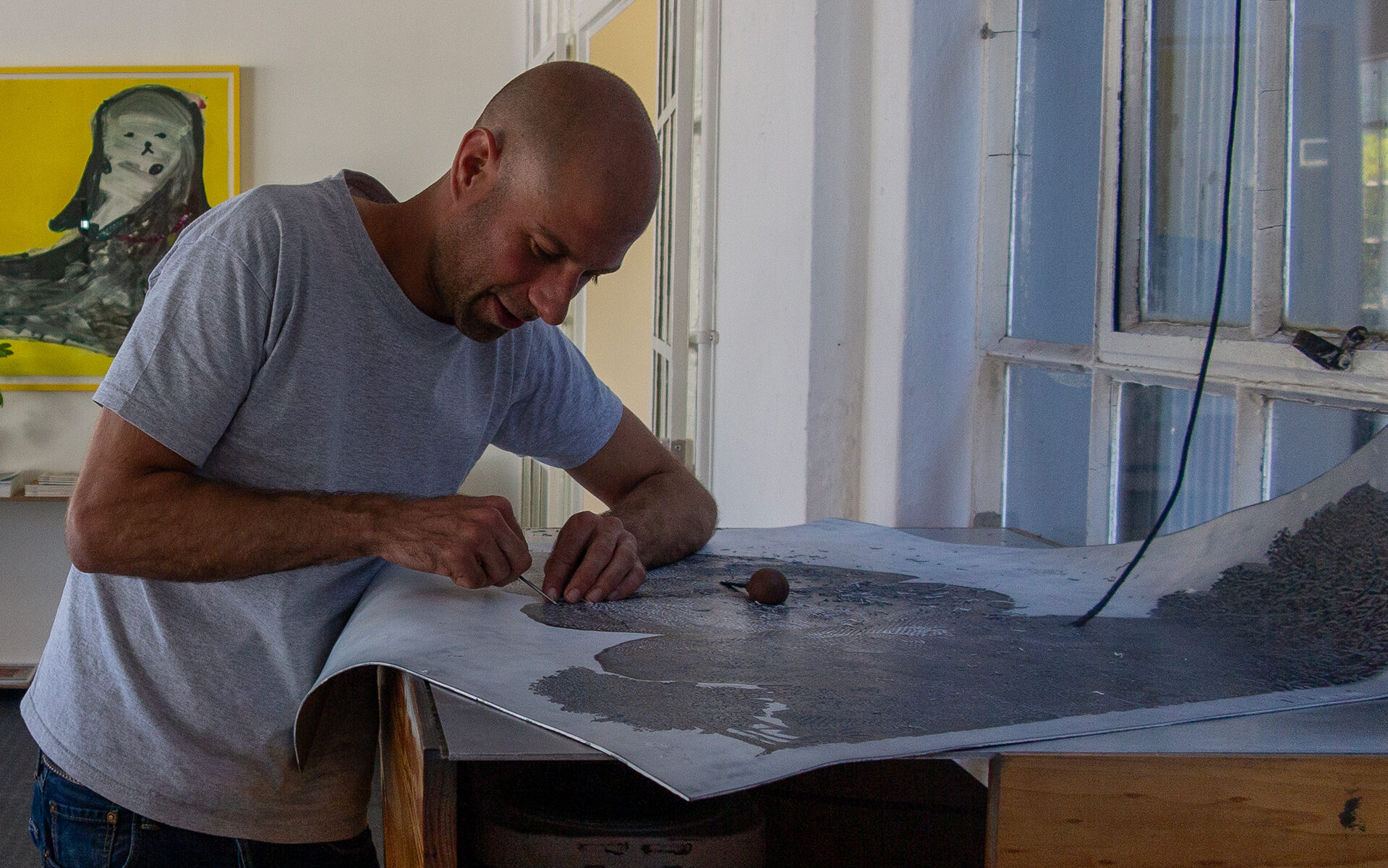
With the graphic punch of a relief print and the elaborate line game of engraving, Dan Halter’s meter-tall linocut of rocks was a strong presence at the E/AB Fair in November. It came by both qualities honestly: the image that Halter spent a month cutting out of linoleum flooring was an enlarged reiteration of an engraving that had adorned every iteration of the Zimbabwean dollar for the entirety of its hapless existence.
A Zimbabwean artist who lives in South Africa, Halter uses a variety of media, though most of his work takes the form of tightly woven digital prints. His primary subject is the complicated interplay of cultural, national and racial identities that circulate in southern Africa, and his references roam from Guy Fawkes to African basketry to failed Google-map searches. He has made a large number of works that play on the appearance of the cheap Chinese woven-plastic carryalls that are a badge of immigrants worldwide (in Nigeria they are known as “Ghana-must-goes”; in Germany they are Türkenkoffers [Turkish suitcases]).
(Domboremari is not the only work in which Halter has used Zimbabwean currency: Computer Says No (2016) is a map of Zimbabwean farming regions, woven from shredded bank notes whose cumulative value totals 2,147,483,647, or 2³¹-1, the maximum declared integer in 32-bit computing, and thus the maximum possible score or cash amount in many digital games.)
The scale of Halter’s linocut necessarily calls attention to the familiar visual language of engraving, a European export that subsumed the world in its representations. And as a graphic enlargement of an official instrument of national identity and governance, Domboremari has echoes of KP Brehmer’s enlarged linocut postage stamp enlargements of the 1960s, but unlike Brehmer, Halter isolates the image from its function and doesn’t immediately reveal his source.
Anyone from Zimbabwe, however, would instantly recognize the Chiremba Balancing Rocks (one of a number of similar geologic formations that resulted from the erosion of softer stone around granite) as a vivid emblem of economic collapse.
Introduced in 1980 to replace the Rhodesian dollar, the Zimbabwean dollar began at parity with the U.S. dollar; by 2007 it was trading at 600,000 to one. Three successive devaluations did nothing to halt the fall, and by 2008 the central bank notes were in hundred-trillion-dollar denominations. Hyperinflation finally killed the currency altogether in 2009; today transactions in the country employ foreign currencies. The color variants in which Halter has printed his block—blue, pink and green—are a nod to the asymptomatically cheerful chromatic variation used to distinguish new currency from old after each devaluation.
Wikipedia notes that the high value Zimbabwean notes “have gained considerable interest from the numismatic community and buyers in general for its absurdity rather than the design.” Halter’s print relies on both—the absurdity and tragedy comprehensible to some, the peculiar visual grace available to all.
https://www.instagram.com/danhalter/


Biography
Dan Halter’s artistic practice is informed entirely by his position as a Zimbabwean living in South Africa. His work confronts his sense of a dislocated national identity, human migration and the dark humour of present realities in Southern Africa. Halter employs everyday materials that are familiar in Zimbabwe and the South.
Africa, adopting local popular visual strategies to engage with the politics of the history of oppression in Southern Africa that continues today. Halter’s work often exploits the notions of craft and curio within a conceptual fine art context.
Dan Halter was born in Zimbabwe in 1977. In addition to five solo exhibitions, Halter has participated in numerous group shows, including the US at the South African National Gallery, curated by Simon Njami, Zeitgenössiche Fotokunst aus Südafrika at the Neuer Berliner Kunstverein (NBK), 2009 Havana Biennale and Earth Mattersat the Smithsonian National Museum of African Art in Washington DC. He has completed four international residencies in Zürich, Rio de Janeiro, Scotland and Turin. Recent exhibitions include the 7th Triennial of Contemporary Textile Arts of Tournai, Belgium and Dan Halter / Mappa Del Mondo at the Nassauischer Kunstverein in Wiesbaden, Germany.
Halter’s also work appears in several collections including, The South African National Gallery, UNISA (University of South Africa), University of Cape Town, Scheryn Collection, Artphilein Collection, Pigozzi Collection, SAFFCA Collection, Round About Collection, and the prestigious Rennie Collection.
Dan Halter lives and works in Cape Town, South Africa.
About the Domboremari series
Dan Halter’s large linocut series, Domboremari, is based on an engraving of the balancing rocks found southeast of Harare, off the Chiremba Road, which became a prominent feature on most Zimbabwean banknotes. Due to the hyperinflation in Zimbabwe, four different sets of this currency were issued, resulting in the need to re-denominate the currency, and the notes were printed in numerous colours.
The Zimbabwean dollar as an official currency was effectively abandoned in 2009. Since then, various currencies have been accepted, although most transactions are in US dollars. Recently, the circulation of US dollars has begun to dwindle. As a result, the Reserve Bank of Zimbabwe has reintroduced local bond notes. This idea has been very controversial in light of what happened to the previous legal tender, which peaked in 2008 and left every citizen a poor billionaire.
At the height of inflation, one US dollar could fetch 300 trillion Zimbabwean dollars on the black market. The largest banknote was Z$100 trillion. These banknotes are now available to purchase as collector’s objects at tourist hubs such as Green Market Square in Cape Town or online from Banknote World, Great American Coin Company, One Hundred Trillion and Google.
Halter carved his image in linoleum flooring over a month. Warren Editions has published six editions, each in a particular colour – referencing colours used on the bank notes. The title, Domboremari, is Shona and means ‘the money rocks’.

Domboremari (Red)
2015/2017
Linocut on Zerkall Litho 300 g/m²
Edition of 6
Paper dimensions: 100 x 81 cm
Price R32000 | Email to Purchase

Domboremari (Bronze)
2015/2017
Linocut on Zerkall Litho 300 g/m²
Edition of 6
Paper dimensions: 100 x 81 cm
Price R32000 | Email to Purchase

Domboremari (Grey)
2015/2016
Linocut on Zerkall Litho 300 g/m²
Edition of 6
Paper dimensions: 100 x 81 cm
Price R32000 | Email to Purchase

Domboremari (Green)
2015/2016
Linocut on Zerkall Litho 300 g/m²
Edition of 6
Paper dimensions: 100 x 81 cm
Price R40000 | Email to Purchase

Domboremari (Pink)
2015/2016
Linocut on Zerkall Litho 300 g/m²
Edition of 6
Paper dimensions: 100 x 81 cm
Price R32000 | Email to Purchase

Domboremari (Blue)
2015
Linocut on Zerkall Litho 300 g/m²
Edition of 6
Paper dimensions: 100 x 81 cm
SOLD OUT | Estimated secondary market value R45000