
Capitalising ‘Artist’—turning a noun into a title or role—reveals psychological aspects related to identity, self-perception, status, and the desire to elevate or defend one’s creative role.
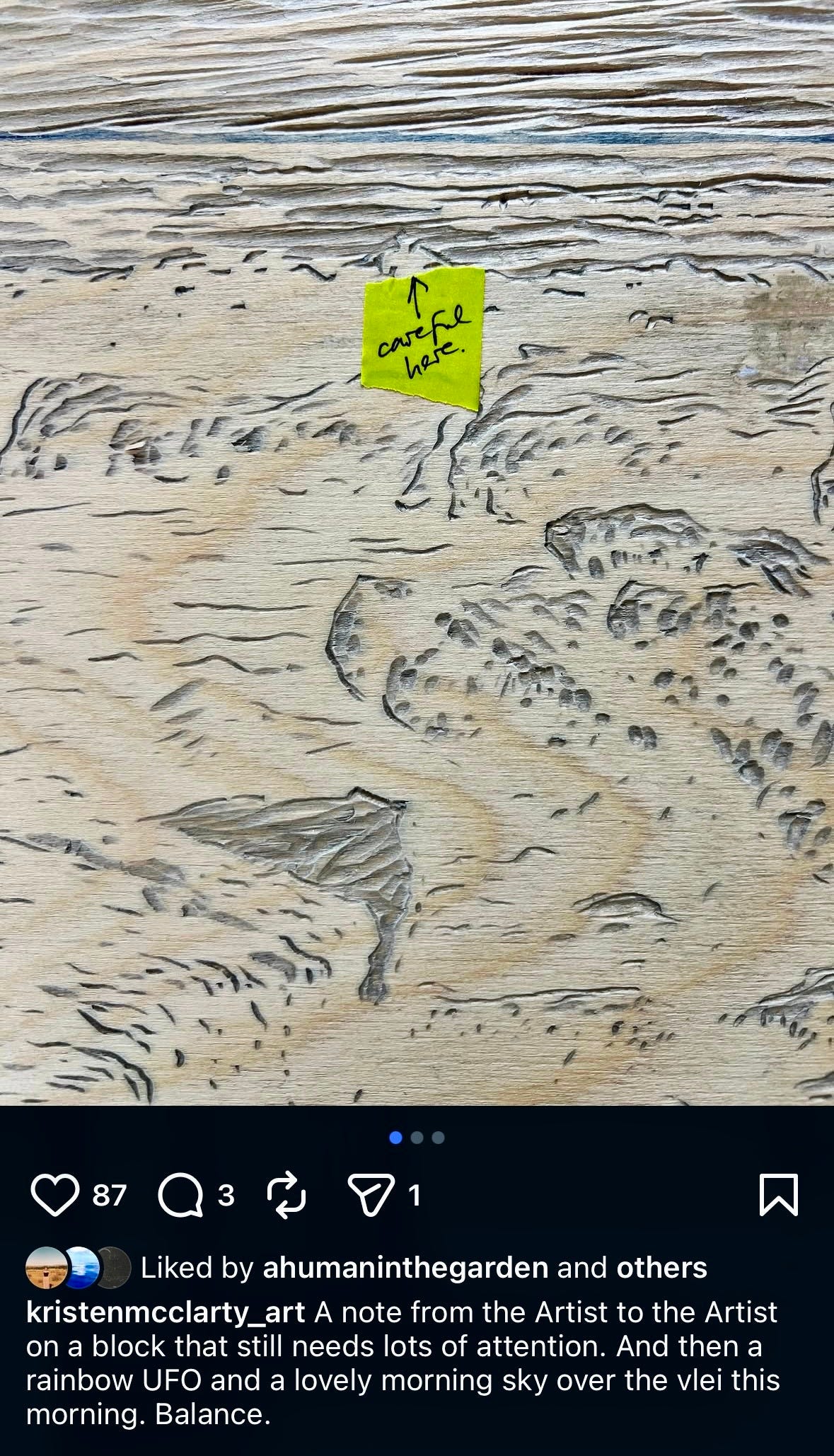
In an Instagram caption, South African printmaker Kristen McClarty writes: “A note from the Artist to the Artist on a block that still needs lots of attention.” That single capital letter is a small but charged choice. It elevates the artist from an ordinary occupation to something closer to an archetype, transforming the everyday act of carving a woodblock into a more ceremonial, reflective dialogue.
In standard English, we don’t capitalise occupations such as doctor, teacher or artist. Doing so deliberately breaks convention in a way that echoes how we treat exalted concepts: Art (with a capital A), Truth, Beauty, or the historical figure of the Artist as a tormented genius or visionary. This isn’t neutral typography. Historically, “Art with a capital A” has distinguished fine art (elevated, autonomous, often non-commercial) from craft, design or hobbyist making. By borrowing that prestige, the capital A places the person within a rarefied tradition rather than as a mere practitioner.
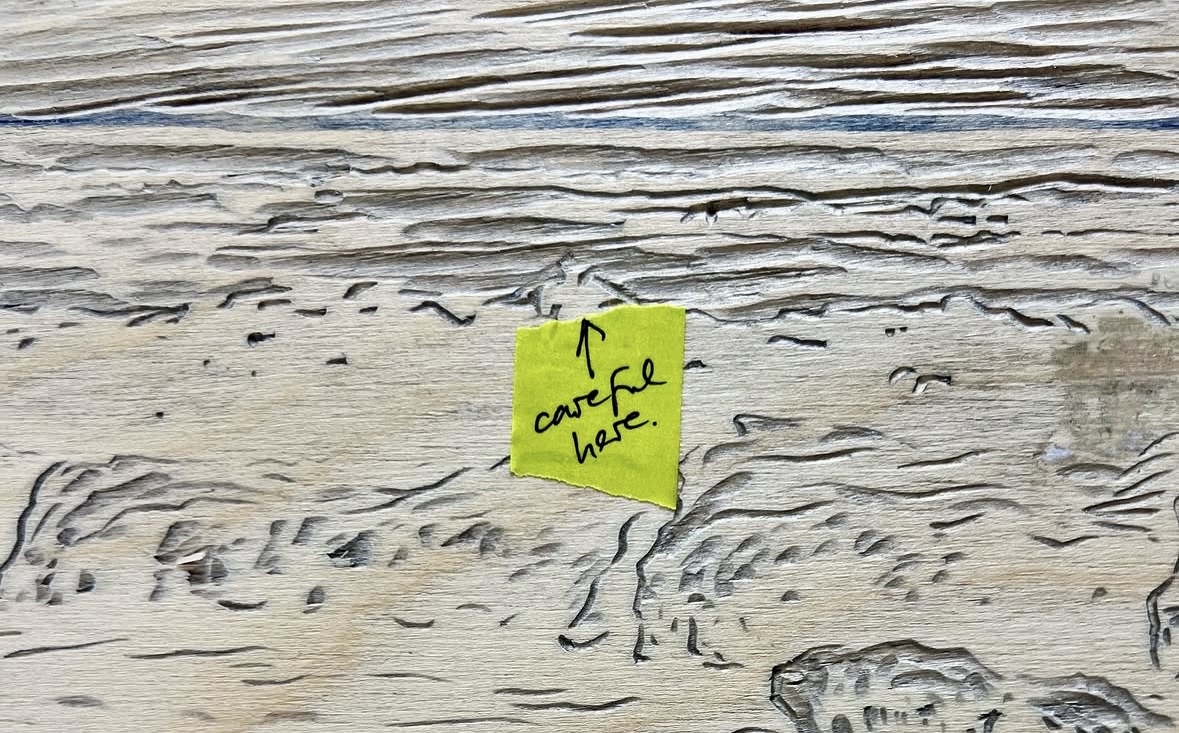
In McClarty’s post—a photo of a handwritten note on a torn piece of tape stuck to her large woodblock, reading “careful here” beneath a drawn arrow—the phrasing creates a gentle split in self-perception. One Artist leaves a warning for the other, as an internal conversation between the everyday maker (hunched over the physical block, navigating the carving) and the elevated Artist (the one whose work carries cultural weight and deserves this level of attention).
The caption remains humble: the block “still needs lots of attention,” acknowledging the slow, iterative, often unforgiving nature of carving a woodcut. Yet framing this as communication between Artists dignifies the entire process, transforming solitary studio labour into a poetic, almost reverent exchange.
Psychological Layers
This capitalisation serves multiple psychological functions for a working artist:
1. Self-affirmation and armour against doubt. Creative work, especially in a demanding medium such as woodcut, entails routine rejection, uncertainty, isolation and imposter feelings. The capital A becomes a quiet ritual of reinforcement: Even at this unfinished, messy stage, I am the Artist. It counters external scepticism and internal insecurity by anchoring the self in a stronger identity.
2. Self-compassion paired with accountability. The note is both gentle and motivating. It reframes drudgery (more carving ahead) as part of a dialogue with one’s higher creative calling, blending tenderness with the discipline required to persist.
3. Identity fusion and status signalling. In creative communities and on platforms like Instagram, the label Artist carries cultural cachet. It fuses the person’s self-concept with a lineage of visionaries, elevating personal expression to cultural significance. For McClarty, this has become a recurring stylistic signature across her studio posts, reinforcing the way she narrates her practice—landscape-inspired woodcuts of rocks, theatrical spaces, and windswept scenes—as serious, reflective work.
4. Ego, romantic idealism and potential pretension. An initial reaction that the caption is egotistical is understandable. To an outside observer, it can read as self-importance or performative elevation. E.E. Cummings satirised this in his essay “The Agony of the Artist (with a capital A),” noting how society (and artists themselves) romanticise the role as one of temperament, suffering, and exceptionalism.
Yet for many creators, a degree of ego isn’t mere vanity—it’s psychological survival. The ego needed to demand attention for one’s work often co-exists with low self-esteem, born of constant comparison and criticism. The capital A can be both armour against the former and a balm for the latter.
At the same time, the humility of McClarty’s caption undercuts heavy pretension. It feels more like affectionate, playful self-address or poetic personification than a grand declaration—like writing “a message from the Writer to the Writer” during a tough draft. In the broader context of her recent Instagram posts (progress updates on carving the large block, exhibiting at Art on Paper XVII, and plans for printing at Warren Editions), the capitalisation consistently elevates the process without detaching it from its realities.
Broader Context
This quirk taps into deeper human needs: the desire for distinctiveness, the cognitive framing that recasts struggle as virtue, and the cultural inheritance of the Artist as outsider, prophet or dedicated craftsperson. In today’s democratised creative spaces (social media, gig economies), it pushes back against the flood of “content creators” by reclaiming seriousness. For some viewers, it empowers or resonates; for others, it creates distance, feels unnecessary or reinforces the sense that social media users present themselves as a product.
Ultimately, writing Artist with a capital A in this intimate studio note is a micro-ritual that performs significant psychological work: asserting value for undervalued creative labour, constructing a coherent self amid uncertainty and sustaining motivation through language. It can be empowering, aspirational, mildly pretentious or all three—depending on the eye of the beholder and the context of the work.